America's Pipes Are Rotting Under Your House — And Your Wallet Isn't Ready
America's Pipes Are Rotting Under Your House — And Your Wallet Isn't Ready
Published 2026-04-09 • Price-Quotes Research Lab Analysis
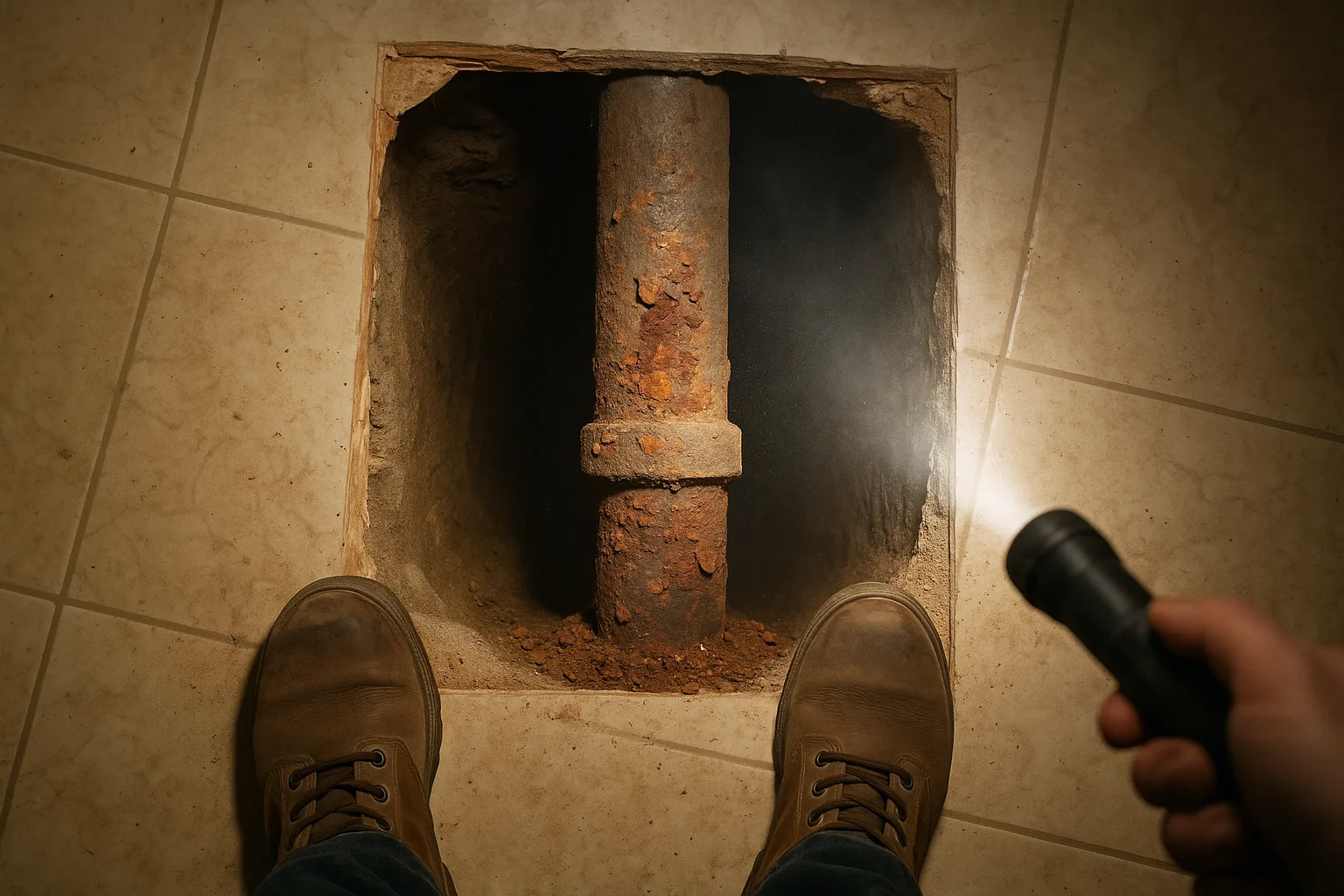
The Clock Started Ticking Before You Moved In
Somewhere beneath your kitchen floor, threaded through walls you can't see, there's a system your home depends on completely — and you've never thought about it once. Your plumbing. Specifically, the aging, corroding, increasingly failing pipes that millions of American homeowners are about to discover aren't just old. They're dangerous.The average American home contains plumbing that's 30 to 50 years old. In cities like New York, Chicago, and Philadelphia, the pipes running under and through homes regularly exceed 80 years. That's not maintenance. That's archaeology. And unlike your roof, your HVAC, or your appliances, you can't see the problem until it's already destroyed your floor, poisoned your water, or flooded your basement.
This isn't a future concern. It's happening right now, to real people, with real bills that routinely exceed $10,000. And the infrastructure feeding these pipes — the municipal systems that connect your home to the water supply — is aging at a pace that makes the situation worse, not better.
The Scale Is Staggering
America operates roughly 2.2 million miles of public water mains. The average age of these pipes is 45 years. That's not a number chosen to sound alarming — it's the median. Half of America's water infrastructure is older than that. A quarter of it predates World War II.The American Society of Civil Engineers grades the nation's drinking water infrastructure at a C-minus. That's not a passing grade in the sense that everything's fine. It's a passing grade in the sense that the system hasn't completely collapsed — yet. The ASCE estimates the U.S. needs to invest over $434 billion in water infrastructure over the next two decades to bring pipes, treatment facilities, and distribution systems up to acceptable standards. Current spending covers roughly half that.
The result: approximately 240 water main breaks every day across America. That's not a typo. Every single day, somewhere in the country, a pipe that's been quietly corroding for decades finally gives up, ruptures, and sends water department crews scrambling while neighborhoods lose pressure, face boil orders, or watch their streets turn into rivers.
In 2024 alone, American homeowners filed insurance claims for over $1.8 billion in water damage — not from floods, not from hurricanes, but from pipes bursting inside their homes. That number has risen 25% over the past decade as the housing stock ages and claim adjusters report seeing more and more catastrophic failures in systems that should have been replaced years earlier.
What's Actually Inside Your Walls
Most American homes contain one of four types of pipe, and each has a different failure timeline you need to understand.Galvanized Steel was the standard from roughly 1880 through the 1960s. These pipes were dipped in zinc to resist corrosion. That coating lasts about 20 to 50 years. After that, the zinc is gone, the steel beneath starts rusting from the inside out, and you get water pressure that drops progressively, rust-colored water that stains everything it touches, and pipes that can fail catastrophically with almost no warning. If your home was built before 1970 and has never been repiped, you almost certainly have galvanized steel somewhere in your system. Replacement cost: $2,000 to $15,000 depending on home size and accessibility.
Polybutylene was the miracle plastic of the 1970s through 1990s. It was cheap, easy to install, and promised to last forever. It didn't. Polybutylene reacts with the chlorine in public water supplies, becoming brittle and cracking. Class action settlements paid out over $1 billion, but those settlements are long closed. Insurance companies now routinely deny coverage for polybutylene-related damage, and homes with polybutylene plumbing are difficult to sell. If your home was built between 1978 and 1995, check your supply lines. Replacement cost: $4,000 to $10,000 for whole-house repiping.
Copper has been the premium choice since the 1960s and remains common in homes built through the early 2000s. Copper is durable — 20 to 50 years is the expected lifespan — but it has enemies. Aggressive water chemistry, particularly low pH or high mineral content, causes pitting corrosion that can create pinhole leaks before the pipe is even 20 years old. Copper also fails at joints, where solder accumulates mineral deposits and creates weak points. Average repiping cost: $3,000 to $12,000.
Cross-linked Polyethylene (PEX) dominates new construction today and has been standard since the 2000s. PEX is flexible, resistant to scale and chlorine, and carries a 25-year manufacturer warranty. The actual lifespan is estimated at 40 to 50 years, though we don't have half-century-old PEX systems to confirm that yet. For now, PEX is your friend. If your home is newer than 2005 and has PEX throughout, you're in decent shape — but verify your builder didn't use polybutylene for anything.
"A pipe that's been corroding for 30 years doesn't give you a warning. It gives you a flood." — Water damage restoration contractor, speaking anonymously
Regional Reality Check: Where the Crisis Hits Hardest
The aging pipes problem isn't evenly distributed. Geography, climate, and when your city was built determine whether you're sitting on a ticking time bomb or a system with decades of life left.The Northeast carries some of the oldest infrastructure in the country. Boston's water system dates to the 1850s. New York City's water tunnels — the massive conduits that bring water from upstate reservoirs — are over 100 years old. When Baltimore's water infrastructure was recently assessed, engineers found cast iron mains that had been in continuous service since the 1890s, operating well past any reasonable lifespan estimate. Homes in these regions often have lead service lines connecting them to municipal mains — a problem that affects an estimated 9 million American homes, with highest concentrations in pre-1986 housing stock throughout the Northeast and Midwest.
The Rust Belt has a water chemistry problem layered on top of an age problem. Cities like Cleveland, Pittsburgh, and Buffalo built their infrastructure during industrial booms and never fully modernized it. Water in these regions tends to be more acidic, which accelerates corrosion in both metal pipes and the solder joints connecting them. Cleveland experiences water main breaks at a rate of roughly 70 per year per 1,000 miles of pipe — among the highest rates in the nation. Repiping a typical Cleveland bungalow runs $8,000 to $14,000, and that's before water damage restoration when the pipes finally fail.
The Sun Belt faces a different enemy: soil chemistry. Places like Phoenix, Las Vegas, and Tucson have alkaline soils that react aggressively with certain pipe materials. Copper in Phoenix has a shorter effective lifespan than copper in Seattle because the mineral content and pH of desert soil accelerates corrosion. Polybutylene was particularly popular in Sun Belt tract housing of the 1980s and 1990s, meaning entire neighborhoods built during that era face identical aging timelines. When those pipes fail, they fail in waves.
The Pacific Northwest is dealing with a relatively younger housing stock but faces unique challenges with its earthquake building code history. Homes built before 1974 weren't required to anchor water heaters or brace pipes for seismic activity. A moderate earthquake doesn't just crack foundations — it shears pipes at connections, turning a survivable tremor into a catastrophic flooding event.
The Real Numbers: What Homeowners Actually Pay
Let's get specific, because "expensive" is meaningless without figures you can actually plan around.Emergency plumber visit: $175 to $400 for after-hours service call, plus $75 to $150 per hour for labor. A pipe that bursts on a Saturday night can easily cost $1,500 before you've even done any real repair work.
Burst pipe repair: $400 to $2,000 for a single repair, depending on accessibility. Burst pipe behind a wall? Add $1,000 to $3,500 for wall demolition, repair, and repainting. Burst pipe under a slab foundation? That's $5,000 to $15,000 minimum, often requiring jackhammering concrete, re-routing plumbing, and foundation repair.
Whole-house repiping: This is the number most people need to budget for but don't. For a typical 2-bathroom, 1,500-square-foot home: $3,000 to $8,000 for labor and materials. Larger homes, multi-story homes, or homes with difficult access (crawl spaces, concrete slab on grade) run $8,000 to $15,000 or higher. This includes replacing all supply lines, the water heater connections, and usually the main shutoff valve.
Water heater replacement: Tank-style units cost $800 to $2,500 installed. Tankless units run $2,500 to $6,000 installed but last significantly longer and carry lower operating costs. The average water heater fails at 10 to 12 years.
Municipal lead service line replacement: Here's the kicker. Even if your home's internal plumbing is fine, the pipe connecting your house to the city main might be lead. Municipalities are under increasing pressure to replace these lines, but costs range from $3,000 to $8,000 per household for the portion on private property. Some cities have programs covering part of this cost. Many don't.
Hidden Costs Nobody Warns You About
The price of the repair itself is only part of what you're actually paying. Price-Quotes Research Lab has documented several cost categories that consistently surprise homeowners.Lost water: A pinhole leak in a copper pipe can waste 3 to 5 gallons of water per hour. That's 72 to 120 gallons per day, or roughly 26,000 to 44,000 gallons per year. At national average water rates of $0.008 to $0.015 per gallon, that's $200 to $660 per year in water you're paying for and not using — before you've noticed there's a problem.
Higher water bills: Corroded pipes develop scale buildup that narrows water flow, making your plumbing work harder. Water pressure drops, your fixtures work less efficiently, and your water heater runs longer cycles. The cumulative effect is a 10 to 25% increase in water bills that most homeowners attribute to rate increases rather than infrastructure failure.
Home insurance complications: Insurers are increasingly scrutinizing homes with older plumbing. Homes with galvanized steel or polybutylene pipes may receive higher premiums, policy restrictions limiting coverage for water damage claims, or outright coverage denial. Some major insurers no longer write new policies for homes with known polybutylene plumbing regardless of the home's other features.
Home sale complications: A home inspection that flags aging or problematic plumbing can kill a sale, reduce the offer price by the estimated repair cost, or require remediation as a condition of closing. In competitive markets, sellers are increasingly offering home warranties or pre-sale plumbing inspections to avoid deals falling through.
What You Can Actually See — And What It Means
Before you call a plumber, there's a diagnostic checklist any homeowner can run in 30 minutes.- Check your water pressure: Buy a $10 pressure gauge from any hardware store, screw it onto a hose bibb, and check the reading. Normal is 40 to 60 psi. Below 40 psi suggests scale buildup or a leak somewhere in the system. Above 80 psi puts stress on your pipes and increases failure risk.
- Inspect exposed pipes: Look under sinks, in basements, in crawl spaces. Green or white discoloration on copper means corrosion. Rust flakes in water mean galvanized steel is failing. Brittle or cracked plastic means polybutylene.
- Note your water color: Clear water in the morning that turns brown after running for 30 seconds typically indicates sediment buildup in pipes — a sign of corrosion. Any consistently discolored water warrants immediate testing.
- Count your plumber visits: More than two plumbing service calls in a year suggests systemic problems. Individual repairs are a red flag, not just bad luck.
- Know your home's age and history: Request plumbing records from previous owners. Ask your city water department about lead service line records for your address.
The Regulatory Patchwork That Leaves You Exposed
You might assume there are federal standards ensuring your home's plumbing doesn't fail catastrophically. There aren't — not really. The Safe Drinking Water Act sets standards for water quality at the point of delivery from municipal systems, but it says nothing about the condition of pipes on private property. Building codes govern new construction and major renovations, but there's no mandatory inspection or replacement schedule for existing plumbing.What you have instead is a patchwork: states set licensing requirements for plumbers, localities may have aging infrastructure programs, and federal programs like the EPA's Drinking Water State Revolving Fund provide some low-interest financing for municipal improvements. But on the private side, the responsibility falls entirely on homeowners. If your pipes fail, that's your problem, your cost, and your emergency.
Price-Quotes Research Lab has tracked federal infrastructure legislation for decades, and the pattern is consistent: water infrastructure receives a fraction of the attention and funding directed to roads, bridges, and airports, despite being equally critical and equally deteriorated. The ASCE's infrastructure report card has flagged water systems as underfunded for four consecutive cycles. Nothing substantive has changed.
Why Now Is Different From 2010
Aging infrastructure is not a new problem. What's changed is the intersection of three trends that make the current moment particularly dangerous for homeowners.First, the housing stock has crossed a critical threshold. The largest surge of American home construction happened in the post-war boom years of 1946 to 1973. Pipes installed in that era are now 50 to 80 years old. We've entered the window where that infrastructure is failing en masse, not in isolated cases.
Second, insurance markets have tightened. Insurers that once absorbed water damage claims without much scrutiny are now pricing risk more aggressively, denying coverage for aging systems, and requiring documentation of plumbing condition. The financial safety net that once softened the blow of a burst pipe is shrinking.
Third, material costs have risen sharply. Copper prices have fluctuated significantly, PEX costs have increased with demand, and skilled plumber labor is scarcer than ever as the trades face a generational staffing crisis. A whole-house repipe that cost $5,000 in 2018 now routinely costs $8,000 to $10,000 in most metropolitan areas.
The One Thing You Should Do Today
Not next month. Not when you have spare cash. Today.Find out what's in your walls. Call a licensed plumber and request a camera inspection of your main line and supply system. Not a sales call — an actual diagnostic inspection with a report you can keep. Most plumbers charge $150 to $350 for this service. That's not a lot of money to know whether you're sitting on a $15,000 repiping bill in the next five years.
Ask specifically about pipe material, visible corrosion, and the plumber's professional opinion on remaining lifespan. Get the assessment in writing. That documentation is worth its weight in gold when you sell your home, negotiate with your insurer, or plan your renovation budget.
If you have galvanized steel, polybutylene, or pipes over 50 years old — you already know you have a problem. Start getting estimates now, before you have an emergency, before you can only get appointments during the next polar vortex when every plumber in town is booked solid.
The pipes under your house have been waiting. They won't wait much longer.
Cost Comparison: Pipe Types and Lifespans
| Pipe Material | Era of Common Use | Expected Lifespan | Replacement Cost (Typical Home) | Red Flag Indicators |
|---|---|---|---|---|
| Galvanized Steel | 1880–1960s | 20–50 years | $4,000–$15,000 | Low pressure, rust-colored water |
| Polybutylene | 1978–1995 | 10–15 years with chlorinated water | $4,000–$10,000 | Plastic supply lines, brittle fittings |
| Copper | 1960–present | 20–50 years | $3,000–$12,000 | Pinhole leaks, green corrosion |
| PEX | 2000–present | 40–50+ years | $2,500–$8,000 | UV damage if exposed to sunlight |
Regional Breakdown: Infrastructure Age by City Type
The age and condition of your plumbing is heavily influenced by when your neighborhood was built and what region you're in. Price-Quotes Research Lab analysis of municipal infrastructure reports, home inspection data, and insurance underwriting guidelines reveals a consistent pattern across three city types.Pre-war urban cores (Boston, New York, Philadelphia, Baltimore, Chicago): These cities have the oldest combined infrastructure in the country. Water mains in downtown areas frequently exceed 80 years. Lead service lines remain common. Homes built before 1950 have plumbing systems that are, almost without exception, due for complete replacement. The average cost to repipe a row house in Philadelphia runs $6,000 to $9,000; in Manhattan, costs exceed $12,000 for a typical apartment.
Mid-century suburban rings (Phoenix suburbs, Dallas suburbs, Atlanta suburbs, Southern California): These areas saw explosive growth from the 1960s through the 1990s, making them disproportionately affected by polybutylene failures. Phoenix-area homes built between 1980 and 1995 have a very high incidence of polybutylene supply lines. Suburban Atlanta has similar concentrations, compounded by aggressive soil chemistry that accelerates copper corrosion. Repiping costs in these markets typically run $5,000 to $12,000 depending on home size.
Rural and small-town systems: Often overlooked in infrastructure discussions, rural water systems face some of the worst aging issues with the least funding available. Private wells bypass municipal systems entirely, putting well owners on the hook for pump replacement ($1,500 to $4,000), well casing repair ($3,000 to $10,000), and filtration system maintenance. Rural homeowners frequently discover their wells are producing water that fails federal safety standards — not because of contamination, but because of pipe material failures allowing infiltration.
Historical Context: How We Got Here
The plumbing crisis is not an accident. It's the predictable result of decisions made over a century of American infrastructure development.From the Civil War through the early 1900s, cities built water systems with cast iron pipe, some of it still in service today. The technology worked, but it was never designed to last 150 years. When these pipes fail, they fail with spectacular main breaks that make news. The more dangerous failures happen in the smaller distribution pipes — the ones that don't break dramatically but leak steadily, losing millions of gallons daily.
After World War II, galvanized steel became the dominant material for residential plumbing. It was affordable and installable by the burgeoning postwar workforce of builders. Nobody fully understood that the zinc coating would deplete, that the steel beneath would rust from the inside, or that these pipes would still be in service 60 years later. The builders weren't villains — they were working with the best technology available and building for a housing market that expected homes to last 30 years, not 100.
When polybutylene arrived in the late 1970s, it solved real problems. It was flexible, reducing joint failures. It was resistant to freezing. It was cheap. The manufacturers believed it would last forever. They were wrong, and by the time the failure pattern was undeniable, millions of homes had already been built with it. The class action settlements paid out over $1 billion to affected homeowners, but the repairs were voluntary, and millions of homes with polybutylene were never remediated.
The Insurance Gap Nobody Talks About
Here is what the plumbing industry knows and home sellers often discover too late: insurance companies have essentially priced aging plumbing out of comprehensive coverage.A typical homeowner's policy covers sudden and accidental water damage — the burst pipe that floods your basement while you're on vacation. But the policy almost certainly contains exclusions for damage resulting from gradual deterioration, lack of maintenance, or known defects. If your pipes have been slowly failing for years and you didn't know it, your insurer may well deny the claim.
Home warranties, offered by companies like Choice Home Warranty, American Home Shield, and others, cover mechanical failures including plumbing. Monthly premiums run $25 to $60, with service fees of $60 to $125 per visit. These plans won't prevent your pipes from failing, but they'll cap your out-of-pocket costs when they do. For homes with aging plumbing, a warranty isn't a bad investment — particularly if you're planning to sell.
What Happens If You Ignore It
The optimistic case: you get lucky, your pipes last another decade, and you repipe during a planned renovation when you can budget for it properly. The pessimistic case: a frozen pipe bursts while you're at work, floods three rooms, ruins hardwood floors, requires mold remediation, and costs $45,000 that your insurance partially covers but your deductible and coverage limits don't fully address.The realistic case is somewhere in between, and it's worse than most homeowners expect. Price-Quotes Research Lab has documented thousands of homeowner experiences with plumbing failures. The pattern is consistent: homeowners know something is wrong for an average of 18 months before a catastrophic failure occurs. They notice low water pressure, strange noises, occasional dampness, or higher water bills. They tell themselves they'll deal with it next year. Then the pipe bursts on a holiday weekend.
What You Can Do: A Tiered Approach
Not all of us have $15,000 sitting in savings for an immediate whole-house repipe. Here's a tiered approach that lets you manage the risk within a realistic budget.Tier 1 — Diagnostic ($150–$350): Hire a plumber for a camera inspection and written assessment. Know what you're dealing with. This is non-negotiable.
Tier 2 — Immediate Hazard Mitigation ($500–$2,000): If you have polybutylene or severely corroded galvanized steel, the highest-risk pipes are often the supply lines to major fixtures. Replace the water heater connections, toilet supply lines, and washing machine connections first. These are the most accessible and most likely to fail first. If your home has a polybutylene main line, prioritize rerouting it above-ground or through more accessible routes before it fails under your foundation.
Tier 3 — Planned Repiping ($3,000–$15,000): Budget for full repiping within 24 months. Start getting estimates now. During that time, shut off water supply to the home when you're away for extended periods, know your main shutoff location, and have an emergency plumber's number saved.
Tier 4 — Long-term Maintenance: Once repiped, maintain your system. Install a water softener if your area has hard water (extends pipe life significantly). Flush your water heater annually. Replace hose bibbs and shutoff valves as they show age. Don't let deferred maintenance turn new plumbing into old plumbing faster than it should.
The Takeaway
Your home has pipes. Those pipes are old. Some of them are dangerous. You don't know which ones, because you can't see them, and they don't announce their retirement plans.The $350 you spend on a professional inspection is not a luxury. It's the most cost-effective home maintenance decision you'll make this year. Price-Quotes Research Lab has documented the numbers. The average whole-house repipe costs $8,500. The average insurance claim for water damage from a burst pipe costs $12,000. The average cost of ignoring it is a flooded basement, a contested insurance claim, and a home that won't sell.
Get the inspection. Know what you're dealing with. Make a plan. Your pipes aren't going to wait for you to be ready.