Tankless Water Heater Installation Costs in 2026: Gas vs Electric, Brand Comparison, and Hidden Fees
Tankless Water Heater Installation Costs in 2026: Gas vs Electric, Brand Comparison, and Hidden Fees
Published 2026-04-10 • Price-Quotes Research Lab Analysis
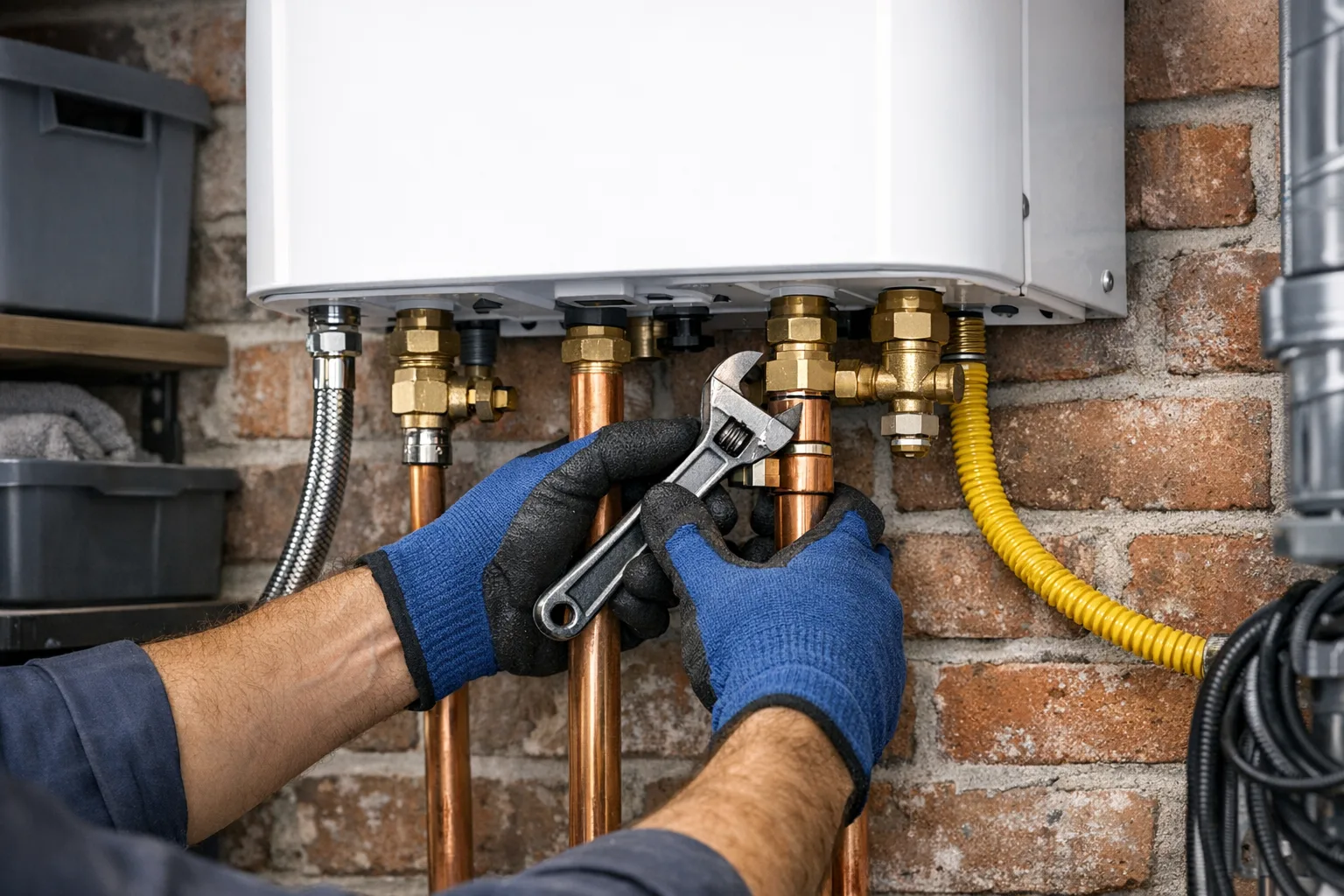
The $9,000 Surprise Nobody Tells You About
Most homeowners budget $1,400 to $5,600 for a tankless water heater installation. What they don't budget for: the reality that complex installs—those requiring new gas lines, upgraded electrical panels, or rerouted venting—can swallow $5,000 to $9,000 or more. That's not a worst-case scenario. That's a Tuesday in suburban America, where half the housing stock wasn't built for on-demand systems. This guide from Price-Quotes Research Lab tears apart the real numbers so you can stop guessing and start planning.
What Is a Tankless Water Heater, Exactly?
A tankless water heater heats water on demand rather than storing a reservoir of hot water at a constant temperature. When you open a hot water tap, cold water travels through the unit, where either a gas burner or electric element heats it instantly. The result: endless hot water, no tank to run dry mid-shower, and—according to the Department of Energy—up to 34% less energy use for households that limit daily hot water consumption to 41 gallons or less.
The technology has been around for decades in Europe and Japan, where space comes at a premium. In the United States, adoption accelerated after the 2009 federal tax credits made them more affordable. By 2026, they're no longer a niche product—they're a mainstream upgrade, with every major HVAC and plumbing brand throwing their hat in the ring.
But here's what the marketing glossies don't tell you: the unit cost is only half the conversation. Installation costs frequently exceed the purchase price, and the gap between a straightforward swap and a full re-pipe can be the difference between a smart investment and a financial headache.
Gas vs. Electric Tankless Water Heaters: The 2026 Showdown
Your fuel choice dictates everything—cost, installation complexity, performance in cold climates, and long-term operating expenses. Here's how the math shakes out in 2026.
Gas Tankless Water Heaters
Gas models run on natural gas or propane and deliver higher flow rates—typically 6 to 10+ gallons per minute (GPM)—making them the practical choice for large households running multiple showers, appliances, and fixtures simultaneously.
Unit costs: $950 to $3,800 for the equipment alone, according to Remodeling Expense. High-end condensing units with modulating burners and advanced heat exchangers push toward the upper end.
Installation complexity: Significant. Gas units require proper venting (often stainless steel for direct vent or power vent setups), a dedicated gas line with adequate pressure, and clearance from combustion-friendly materials. If your current gas line is undersized or your home uses an atmospheric vent system designed for a tank, you're looking at added costs that can double the install price.
Operating costs: Generally lower than electric in regions with affordable natural gas. A gas tankless unit typically costs $150 to $400 per year to run, depending on usage and local utility rates.
Performance in cold water: Gas units handle incoming water temperatures as low as 37°F without significant output degradation, making them the preferred choice in northern climates where groundwater temperatures plummet during winter months. Electric units often struggle to maintain target temperatures when incoming water approaches freezing.
Electric Tankless Water Heaters
Electric models use resistance heating elements to warm water on demand. They're compact, lightweight, and don't require venting—a major installation advantage.
Unit costs: $600 to $2,300, per Total Home Supply. Electric tankless units occupy a lower price tier than their gas counterparts, making them attractive for point-of-use applications (under a single sink, for a specific bathroom) or smaller homes with modest hot water demands.
Installation complexity: Lower for the unit itself, but electrical requirements can still be punishing. Most whole-house electric tankless units require a 120- to 200-amp electrical service and a dedicated 60- to 80-amp circuit. If your electrical panel is full or your service is undersized, upgrading can add $1,500 to $3,000 to the project.
Operating costs: Higher in most regions due to the premium pricing of electricity versus natural gas. Expect $400 to $800 annually depending on usage patterns and local utility rates. That said, if you're pairing the unit with solar panels or live in an area with time-of-use electricity rates, the calculus shifts.
Performance in cold water: The weak link. In regions where groundwater temperatures drop into the 40s during winter, electric units may only deliver 2 to 3 GPM at a usable temperature—insufficient for a household running multiple hot water draws simultaneously. Heat pump water heaters offer a hybrid alternative, but they're a different product category.
The Bottom Line on Fuel Choice
If you have natural gas available and live in a cold climate, gas is the stronger performer. If you're electrifying your home, want a point-of-use solution, or lack gas infrastructure, electric works—but run the numbers carefully. A $2,000 electric unit that requires a $3,000 panel upgrade isn't a bargain regardless of its Energy Star rating.
2026 Tankless Water Heater Brand Comparison
The tankless market has consolidated over the past decade, with a handful of manufacturers controlling the premium and mid-market segments. Here's how the major players stack up on price, warranty, and reputation as of early 2026.
Rinnai
Rinnai dominates the premium tankless segment. Their Rinnai RU199iN and similar models offer flow rates up to 11 GPM, built-in recirculation pumps on select units, and some of the longest warranties in the industry—12 years on the heat exchanger for residential use. Unit prices range from $1,200 to $2,800 depending on capacity. Rinnai's Control-R integration with smart home ecosystems gives them a tech edge. The tradeoff: premium pricing and a service network that can be thin outside major metro areas.
Navien
Navien carved out market share by undercutting Rinnai and Rheem while delivering comparable performance. Their NPE-2 series offers condensing technology at non-condensing price points, making them a value play for homeowners who want efficiency without the premium sticker. Units run $900 to $2,200. Navien's 15-year heat exchanger warranty is competitive, and their units are known for handling low gas pressure better than some competitors—critical in older homes with marginal gas infrastructure.
Rheem
Rheem sits at the intersection of accessibility and quality. Their RTG- and RTX-series tankless units are widely stocked at Home Depot and Lowe's, making them easy to source, and their nationwide installer network is deeper than Rinnai's or Navien's. Unit prices range from $700 to $2,400. Warranty coverage varies by model—3 to 5 years on parts, up to 12 years on the heat exchanger depending on the series. Rheem is the safe, available choice, though they don't lead on innovation or ultra-premium performance.
Stiebel Eltron
Stiebel Eltron is the electric tankless specialist. German-engineered and known for bulletproof reliability, their Tempra Plus series dominates the electric whole-house segment. Units range from $500 to $1,500. The trade-off: flow rates max out around 4 to 6 GPM, and performance degrades sharply with cold inlet water. Stiebel Eltron makes sense for mild-climate households with realistic expectations about simultaneous hot water demand.
EcoSmart
EcoSmart occupies the budget-to-mid electric tier. Their 27-kW and 36-kW models deliver competitive flow rates for the price—$400 to $900 per unit—and carry a Lifetime Warranty on the electronics, which is unusually strong for the price segment. Build quality and longevity don't match Stiebel Eltron or Rheem's electric offerings, but for cost-conscious homeowners replacing an aging tank with an electric tankless unit, EcoSmart fills a real need.
The Real Cost of Installation: Line Items Nobody Shows You
The sticker price on a tankless water heater is fiction. The real cost starts with the unit and spirals into territory that surprises even seasoned contractors. Here's what a complete installed cost breakdown looks like for 2026, drawn from HomeGuide and The Examiner News.
Unit Purchase
The water heater itself: $600 to $3,500 depending on fuel type, flow rate capacity, and whether the unit is condensing or non-condensing. Condensing units capture exhaust heat for additional efficiency but cost more upfront—expect to pay $800 to $1,500 above a comparable non-condensing model.
Basic Installation (Straight Swap)
If your existing water heater is gas-powered and your home has adequate gas supply, venting, and clearance, a straight swap runs $500 to $1,200 for labor. A certified plumber typically charges $75 to $150 per hour, and a straightforward replacement takes 4 to 8 hours. You still need to budget for permits—$100 to $400 in most jurisdictions.
New Gas Line Installation
If your gas line is undersized or terminates in the wrong location, a licensed gas fitter must extend or upgrade it. Gas line work runs $300 to $1,500 depending on distance and whether the line runs through finished or unfinished space. In some municipalities, this work requires a separate permit from the plumbing permit.
Electrical Upgrades for Electric Units
Electric tankless units demand serious amperage. A 120-amp subpanel upgrade costs $1,500 to $3,000. Running new dedicated circuits through finished walls adds $200 to $500 in labor per circuit. If your electrical service itself is undersized (common in homes built before 1970), a full service upgrade—panel replacement plus utility coordination—can run $4,000 to $8,000. This is the hidden fee that makes electric tankless upgrades financially ruinous for the unprepared.
Venting and Flue Work
Gas tankless units require proper venting. Non-condensing models typically use Category III stainless steel venting—$15 to $30 per linear foot for the pipe, plus $200 to $500 in labor per vent run. If your installation location is far from an exterior wall or requires routing through multiple joist spaces, vent runs can add $500 to $2,000 to the project. Condensing units can often use cheaper PVC venting, but they require condensate drain lines that add complexity.
Water Line and Isolation Valve Upgrades
Tankless units require full-port ball valves on the inlet and outlet, flexible water connectors, and often a pressure relief valve with a discharge line. Materials run $100 to $300. If your home has galvanized steel or polybutylene supply lines, you'll face the question of whether to leave them as-is or upgrade to PEX or copper—a decision that can add $500 to $3,000 depending on the scope.
Permits and Inspections
Permit costs vary dramatically by jurisdiction. Urban areas with strict codes charge $200 to $800 for a tankless water heater installation permit. Rural areas with minimal oversight might charge $50 to $100—or nothing at all. Never skip the permit. An unpermitted installation can void your homeowner's insurance, create problems during resale, and leave you on the hook for bringing the work up to code after the fact.
Hidden Fees That Blow Past Initial Quotes
Contractors who provide low-ball estimates often exclude line items they know will be necessary but don't want to reveal until they're already inside your house. Be suspicious of any quote that doesn't specifically address the following.
Code compliance upgrades. When a plumber opens a wall or accesses existing infrastructure, they frequently discover code violations from the original installation—missing drip legs, improperly sized gas flex lines, missing earthquake straps, or inadequate combustion air. Fixing these issues is mandatory to pass inspection, and the contractor knows it. If they're not flagging potential code issues in their estimate, they're padding for surprise add-ons.
Water heater isolation valve kits. A basic installation might omit the full isolation valve kit with pressure gauge and thermal expansion tank. These components—$150 to $400 in materials—are essential for system longevity and are sometimes presented as optional upgrades after you've already committed to the job.
Disposal fees. Removing and disposing of the old tank water heater costs $100 to $300, depending on size and accessibility. Some contractors build this into labor; others tack it on as a line item. Ask explicitly.
Demolition and wall repair. If the installation requires cutting into drywall, expect $200 to $600 in patch and paint costs, unless the contractor explicitly states that wall access and repair are included. Gas units in tight closets often require reframing or relocation of existing shelving and storage to meet clearance requirements.
Recirculation system costs. One of the biggest pain points with tankless systems: the lag time between opening a tap and receiving hot water. $500 $1,500 Rinnai
Service call and trip charges. Some contractors charge $75 to $150 per trip for estimates, material drops, or follow-up visits. Factor these into your project budget rather than treating the quoted installation price as the total cost.
Sizing Your Tankless Water Heater: Don't Trust the Box
Buying a tankless water heater based on its GPM rating without calculating your actual hot water demand is the fastest path to buyer's remorse. Oversizing wastes money; undersizing leaves you with lukewarm showers.
Calculate your simultaneous demand first. Add up the flow rates of every hot water fixture that might run at once:
- Kitchen faucet: 1.5 GPM
- Bathroom faucet: 0.5 to 1.0 GPM
- Shower: 2.0 to 2.5 GPM
- Washing machine: 1.5 to 2.0 GPM
- Dishwasher: 1.0 to 1.5 GPM
- Bathtub: 3.0 to 4.0 GPM
A household of four running two showers, one faucet, and a dishwasher simultaneously needs 7.5 to 8.0 GPM. In a cold climate, you'd need a unit rated at 9 to 10 GPM to maintain temperature under that load. Oversize by 1 to 2 GPM as a safety margin.
Temperature rise matters as much as flow rate. If your incoming groundwater is 50°F and you want 120°F output, that's a 70°F rise. Larger temperature rises require more powerful units. Piece of Mind Plumbing recommends choosing a unit that meets your peak demand temperature rise, not just your average demand.
Is It Worth It? The Long-Term Math
Tankless water heaters carry a 2- to 3x higher upfront cost than tank units. The payback period depends on three variables: your current energy costs, your hot water usage volume, and how long you plan to stay in the home.
A gas tankless unit costs $2,000 to $4,500 installed versus $1,200 to $2,500 for a comparable gas tank unit. The energy savings—typically $100 to $250 per year for gas households, $250 to $400 per year for electric households—take 10 to 20 years to recoup the difference. If you plan to sell the home within five years, the resale premium may justify the upgrade even without full energy payback. ENERGY STAR estimates that a tankless unit can increase home value by 3% to 4% in markets where buyers recognize the value of modern, efficient water heating.
The lifespan argument is stronger than the efficiency argument. Tank water heaters last 8 to 12 years on average. Quality tankless units last 20 to 25 years with proper maintenance—descaling in hard water areas, annual inspection of burners and heat exchangers, and replacement of sacrificial anodes on gas models. A single tankless replacement replaces two tank replacements over a 25-year horizon, which partially offsets the higher initial investment.
When to Walk Away from a Tankless Upgrade
Not every home is a good candidate. Skip the tankless upgrade if:
Your home's infrastructure requires more than $5,000 in upgrades to support it. At that point, you're not buying a water heater—you're funding a plumbing and electrical overhaul disguised as a water heater project. Redirect those dollars toward a high-efficiency heat pump water heater, which delivers better efficiency in most climates with less infrastructure drama.
Your household hot water demand is genuinely modest. A single-person home with one bathroom and a dishwasher rarely benefits from whole-house tankless capacity. A point-of-use electric tankless unit under the sink—a $200 to $500 fix—delivers faster hot water at the kitchen faucet without any of the installation complexity.
You live in a hard water area without a softening system. Tankless units scale up in hard water conditions, losing efficiency and eventually failing. If you haven't addressed your water hardness before installing a tankless unit, you're buying a maintenance problem. Water softeners cost $1,000 to $4,000 installed—another line item that belongs in the full project budget.
The Price-Quotes Research Lab Verdict
Tankless water heaters deliver on their promises—endless hot water, longer lifespan, lower operating costs—when the installation is done right in a suitable home. The 2026 market offers more choice, better technology, and more competitive pricing than any point in the past decade. But the installation cost gap between a simple swap and a full infrastructure upgrade remains the industry's best-kept secret, and it's a secret that costs homeowners thousands.
Get three detailed bids. Require itemized cost breakdowns that specifically address gas line capacity, electrical service, venting, permits, and potential code compliance issues. The contractor who provides the clearest, most detailed estimate is almost always the one you want—not the one with the lowest headline number.
Key Questions
How much does a tankless water heater cost with installation in 2026?
Most homeowners pay $1,400 to $5,600 with installation for a whole-house tankless water heater in 2026. Complex installations requiring new gas lines, electrical upgrades, or extensive venting can run $5,000 to $9,000 or more.Is it better to get gas or electric tankless water heater?
Gas tankless units deliver higher flow rates and perform better in cold climates, making them the practical choice for large households. Electric units are cheaper to purchase, require no venting, and work well for point-of-use or smaller home applications, but they demand significant electrical upgrades and struggle with simultaneous hot water demands.What are the hidden fees when installing a tankless water heater?
Hidden fees commonly include gas line upgrades ($300-$1,500), electrical panel upgrades for electric units ($1,500-$3,000), venting and flue work ($500-$2,000), water line and valve upgrades ($100-$300), permit and inspection fees ($100-$800), code compliance repairs discovered during installation ($200-$1,000), and drywall repair after wall access ($200-$600).How long does a tankless water heater last?
Quality tankless water heaters last 20 to 25 years with proper maintenance, including annual descaling in hard water areas and periodic inspection of burners, heat exchangers, and anodes. This roughly doubles the lifespan of a conventional tank water heater.Do tankless water heaters actually save money?
Tankless units reduce energy consumption by 24% to 34% compared to tank systems, saving $100 to $400 annually depending on fuel type and usage. The upfront cost premium takes 10 to 20 years to recoup through energy savings alone, but the longer lifespan, increased home value, and elimination of mid-life tank replacement costs improve the overall return on investment.What size tankless water heater do I need for a family of four?
A family of four running two showers simultaneously needs 7.5 to 8.0 GPM minimum. In cold climates where groundwater drops to 40-50°F in winter, size for 9 to 10 GPM to maintain comfortable temperatures under peak demand. Always calculate your specific temperature rise requirement rather than buying based on GPM alone.Related Services